Blog
By
Nelson Uzenabor

The most popular advice about AI customer service automation is also the least useful: deploy a chatbot, deflect tickets, reduce response time, and call the project successful. That approach optimizes the first few seconds of a conversation while ignoring the outcome customers actually care about, whether their problem gets solved without starting over.
A fast answer that sends a customer back to support is not efficiency. It's a resolution gap. The strongest programs treat AI as an orchestration layer across knowledge, channels, business systems, and human teams. The agent answers routine questions, collects the right context, takes permitted actions, and transfers complex cases without forcing the customer to repeat the story.
Table of Contents
Redefining AI Customer Service Automation
A customer can receive an immediate reply and still have a poor support experience. They may get a generic article instead of an answer, reach a human who can't see the chat history, or move from sales to billing while explaining the same issue at every handoff. The front end feels automated, but the underlying operation remains fragmented.
The resolution gap describes that failure. In a 2026 Liveops study, 28% of respondents said the main irritation was receiving a quick first response but needing to contact support again, while 59% said handoffs are difficult because they must explain the issue again. Only 10% said automated-to-human handoffs are always smooth, according to the same source.
Practical rule: Measure whether the customer reaches a correct resolution, not whether the bot produced a reply.
Modern automation should perform four connected jobs:
Understand intent: Distinguish an order-status request from a cancellation, a technical incident, a pricing question, or a qualified buying signal.
Use controlled knowledge: Answer from current product pages, policies, pricing, help content, and approved internal material rather than improvising.
Complete permitted actions: Retrieve information, collect required fields, create a ticket, qualify a lead, or route the conversation to the right queue.
Escalate with context: Pass the transcript, intent, customer details, attempted steps, and unresolved question to a human.
Deflection still has a place. Routine requests should not consume an agent's attention when a connected system can resolve them accurately. But deflection is a means, not the objective. A customer who abandons the conversation after receiving an irrelevant answer hasn't been served, even if the ticket never entered the queue.
That distinction changes how teams design the experience. The bot should know when it lacks authority, when the available information conflicts, and when a customer's language signals urgency or frustration. It should ask for the order number or account identifier before escalation, then give the human agent a concise explanation of what happened.
Teams evaluating the operational side of this work can find expert automation advice that covers broader workflow design. The same principle applies to customer support: automation creates value when it removes unnecessary effort from the complete process. A company's operating model, customer promises, and escalation responsibilities should also be visible to the people behind the system, including those responsible for its company context and team.
The Current State of AI Support Adoption
AI customer service automation is no longer difficult to pilot. The difficult part is closing the resolution gap between an automated first response and a completed customer outcome. A bot can answer a question quickly and still leave the customer waiting if it cannot access the right system, transfer the case with context, or involve billing, product, or operations when the issue crosses departmental boundaries.
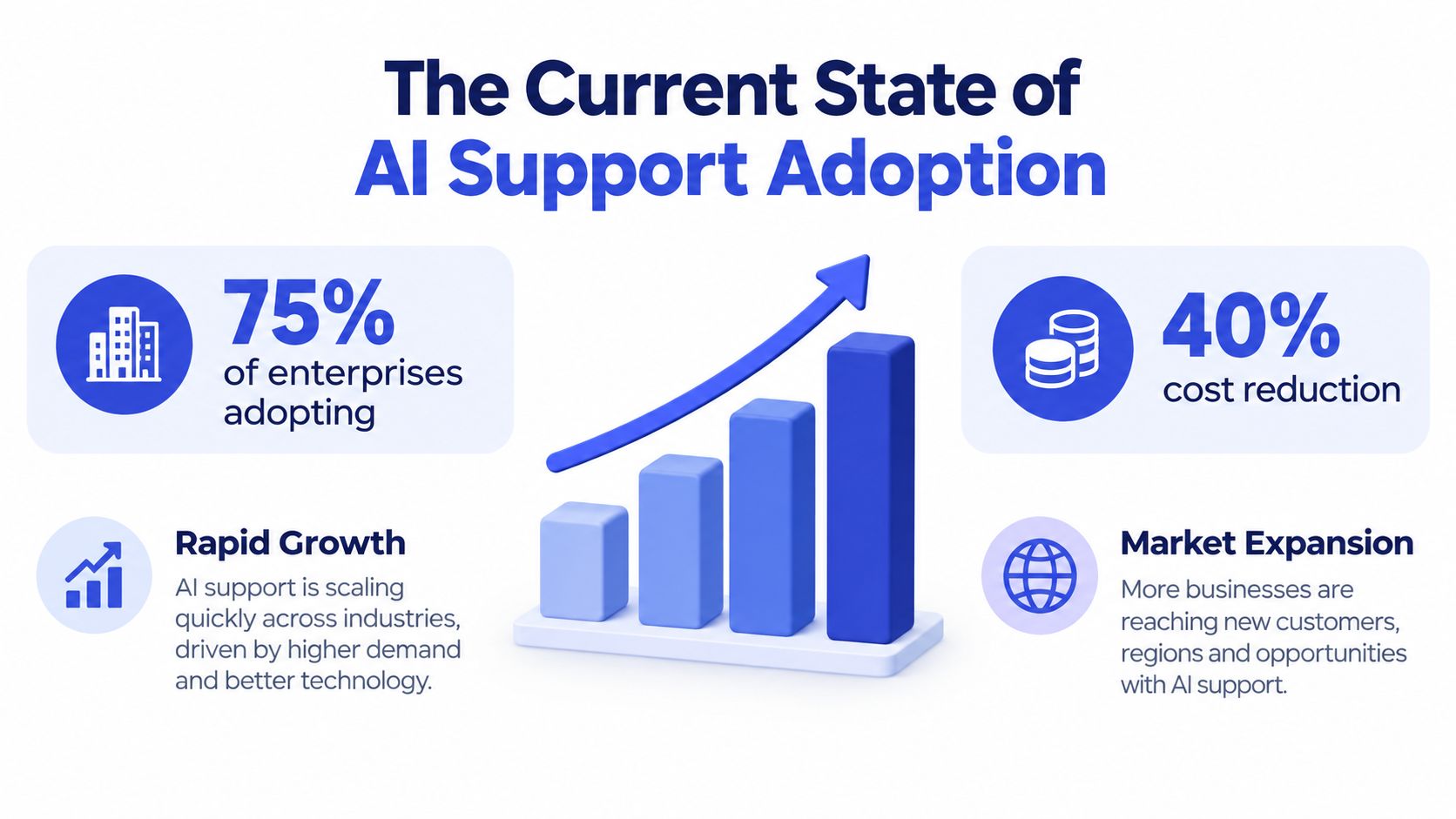
A 2026 industry roundup estimates the global AI customer service market at $15.12 billion in 2026, up from $12.06 billion in 2024, with a projected 25.8% CAGR reaching $47.82 billion by 2030. The figures come from AI customer service market research, which also reports that 88% of contact centers use some form of AI, while only 25% have fully integrated automation into daily workflows.
The adoption figures show how widely teams are testing AI. The integration figure shows where value is still being lost. A business may have an AI assistant, automated routing, or reply generation in one channel, yet lack connections to its CRM, order management, billing records, identity controls, knowledge governance, and human queues.
Adoption is not operational maturity
A pilot can answer routine questions from a help center. Production support must also handle policy changes, permissions, customer identity, retention rules, channel continuity, and failed actions. Someone must own the knowledge sources, review poor answers, and decide which cases require a person.
Customer expectations reinforce that requirement. In a 2025 cross-country survey from Twilio, 87% of organizations said customers want more self-service options, and 83% wanted more AI-powered customer service. Customers are asking for faster access to resolution, not an automated barrier. They may accept self-service for a simple request and expect a prepared employee conversation when judgment, authority, or coordination is required.
Operational maturity rests on the systems around the model. A production implementation should:
Read approved information from a maintained knowledge source.
Identify intent and the next permitted action.
Query or update systems within its permissions.
Preserve context across chat, email, voice, and messaging.
Route exceptions to the right team with a reason and concise summary.
The differentiator is coordinated resolution. AI should connect support with sales, product, finance, and operations, so ownership does not disappear when a request leaves the initial queue.
Real-World Applications Across Industries
The best starting point differs by business model. An online retailer should usually begin with post-purchase questions and returns. A SaaS company may gain more from technical triage and lead qualification. An agency needs repeatable deployment and reporting across client accounts.

E-commerce support starts after the sale
A shopper asking “Where is my order?” isn't looking for a long explanation of shipping policy. They want the current status, a tracking path, and a clear answer if the shipment is delayed. An AI agent connected to order data can collect the order reference, retrieve approved status information, and explain the next step.
Returns require more judgment. The agent can explain eligibility, collect the reason, identify the order, and begin the approved workflow. It should escalate damaged goods, disputed refunds, unusual payment issues, and emotional complaints rather than forcing a policy script onto a sensitive case.
The useful design principle is post-purchase anxiety reduction. Product recommendations may help revenue, but a support agent earns trust first by handling the customer's immediate concern accurately.
SaaS support can join service and sales
For a software company, routine support often clusters around access, configuration, feature discovery, and basic troubleshooting. An agent can guide a user through documented steps, recognize when the issue involves an outage or account permissions, and attach the attempted troubleshooting to a technical ticket.
The same conversation may reveal a buying opportunity. A visitor asking whether a feature supports a larger team, a specific integration, or a particular workflow may need more than a help article. The agent can collect business context and route a qualified lead to sales without interrupting the user's experience.
That handoff must distinguish support intent from commercial intent. A customer with a broken integration needs technical ownership. A prospect comparing plans needs accurate product and pricing information, followed by a sales-ready summary. Teams looking for additional context on conversational buying behavior can review B2B buyer chatbot research data, while validating every claim against their own conversations.
Agencies need repeatable control
A digital agency or consultant can deploy branded agents across client websites, but the operational challenge is consistency. Each agent needs its own approved sources, voice, escalation rules, lead fields, and reporting view. A shared template can accelerate setup, but it shouldn't blur client boundaries or allow one account's information to appear in another.
For agencies serving hospitality or travel businesses, the agent can answer accommodation questions, collect dates and preferences, qualify inquiries, and route complex booking requests. The human team should receive a structured summary rather than a raw transcript. Operational examples from hospitality teams and their stories can help agencies think through the difference between general information and booking intent.
The common thread across all three industries is narrow scope. Start with a workflow where the customer's intent is clear, the source data is dependable, and the next action is defined.
This video offers another way to think about how automated support fits into a broader customer journey.
Your Implementation Roadmap and Best Practices
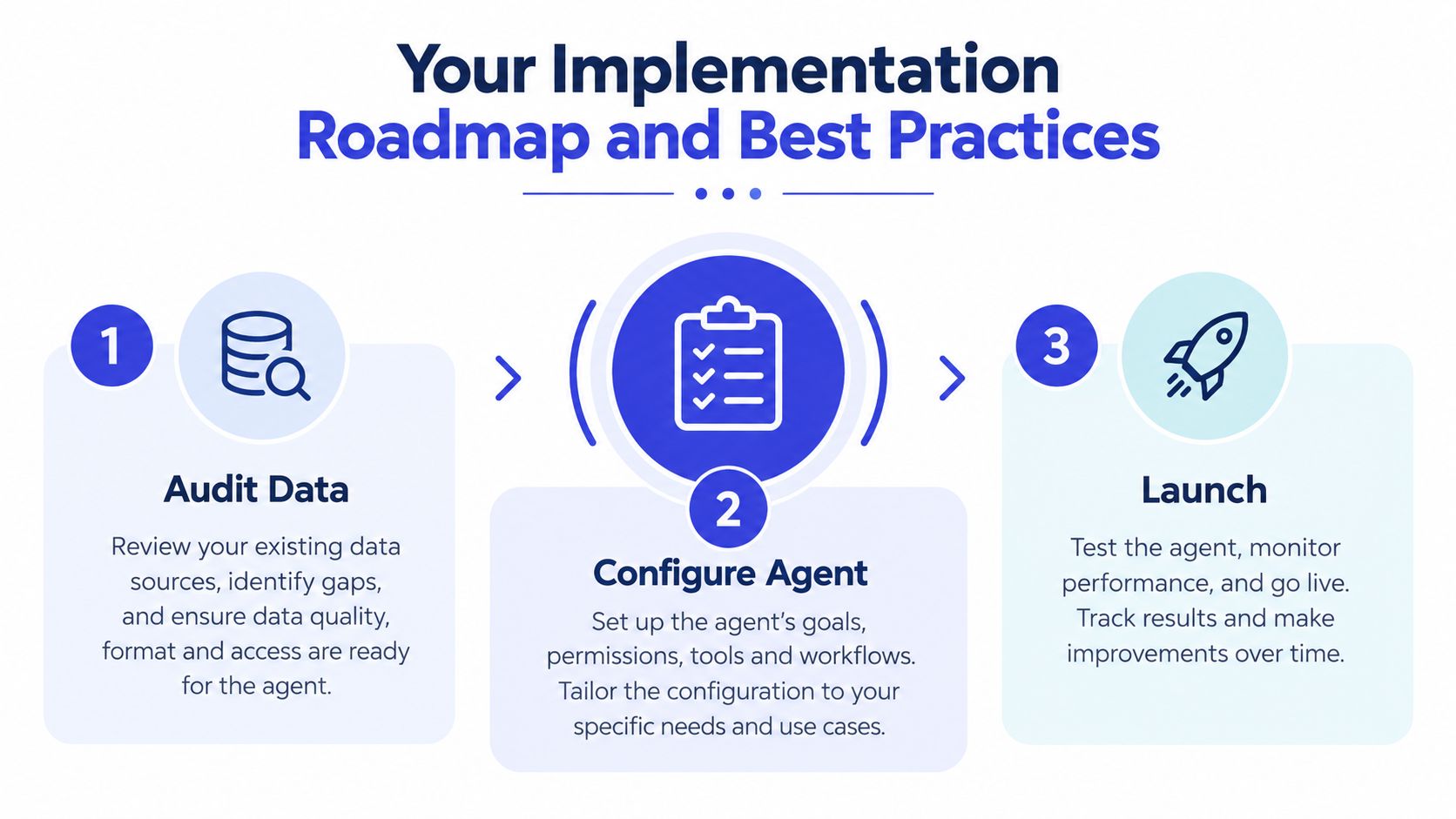
A reliable deployment begins with operations, not a model selection meeting. The first question is not which AI system sounds most capable. It is whether the business can provide accurate knowledge, defined permissions, and a responsible path for unresolved cases.
Start with a knowledge audit
Inventory the sources an agent might use: product documentation, pricing pages, policies, onboarding material, troubleshooting guides, shipping rules, and internal escalation instructions. Remove duplicates, archive obsolete pages, and identify contradictions before connecting anything.
An AI agent can't compensate for a pricing page that conflicts with a sales sheet. It also shouldn't infer a refund exception from a vague policy. Assign an owner to each important source and define how changes reach the agent.
Create a small content test set from real customer questions. Include straightforward requests, ambiguous wording, outdated terminology, and questions the agent must refuse or escalate. Review the responses for factual accuracy, tone, source traceability, and next-step clarity.
Map intents before writing prompts
List the jobs customers are trying to complete, not just the words they use. “I need to change my plan” may involve billing, permissions, cancellation risk, or a sales conversation. Intent mapping should capture those branches.
For each intent, define:
Allowed resolution: What the agent may answer or do independently.
Required information: Which fields must be collected before action or routing.
Restricted conditions: Which words, account states, or requests require a person.
Destination: The correct team, queue, or owner.
Completion signal: What counts as resolved, not merely answered.
Keep the first release focused. A narrow agent with dependable answers is more useful than a broad agent that makes confident guesses.
Design the handoff as a product feature
Escalation should feel like progress. The customer shouldn't have to request a human repeatedly or restate the full issue after the transfer.
Before routing, the agent should gather the details the next team needs. That might include an order reference, account email, device or environment, error message, desired outcome, and relevant conversation history. It should then create a compact summary that separates facts supplied by the customer from actions already attempted.
Handoff standard: A human agent should be able to understand the problem, the customer's goal, and the next sensible action without rereading the entire conversation.
Test failure paths deliberately. Disconnect an integration, provide an unknown order reference, ask for an exception, and introduce conflicting information. The system should explain its limitation, preserve the context, and offer a clear route to assistance.
Launch in a controlled channel or on a high-intent page first. Let support agents review escalations, tag incorrect intent classifications, and identify missing knowledge. Treat those tags as operating data for improving content and routing, not as evidence that the model alone needs more complexity.
Overcoming Integration and Governance Blockers
The hard part of AI customer service automation is rarely the opening message. The substantive work sits behind it, in authentication, permissions, system ownership, data quality, audit trails, and exception handling.
A 2026 outlook from Forrester on AI customer service warns that overautomating complex inquiries can erode satisfaction. A separate 2026 enterprise survey found that only 15% of companies combine agentic AI with cross-departmental orchestration, and that compliance, security, and disconnected systems remain leading blockers. Better model output does not repair a broken service workflow.
Use hybrid ownership deliberately
Routine questions fit automation when the answer is stable and the action is safe. Complex cases still need human judgment, especially where money, access, safety, legal obligations, or emotional distress are involved.
A hybrid design assigns responsibilities explicitly:
AI handles: Repetitive questions, information retrieval, structured intake, basic troubleshooting, and approved routing.
Humans handle: Exceptions, complaints, sensitive account changes, disputes, high-risk decisions, and cases requiring discretion.
Operations owns: Knowledge quality, intent definitions, permission reviews, escalation performance, and change control.
Human oversight is not a temporary concession while the technology matures. It belongs in the support architecture.
Connect systems with boundaries
Disconnected tools create repeated questions and contradictory answers. Support may see a ticket, sales may see a lead, billing may see an account status, and product may hold the incident context. The customer experiences those internal boundaries as repeated explanations.
Integrations should expose only the fields and actions the agent needs. Use role-based permissions, protect personal data, record significant actions, and keep an audit trail for changes. Define what happens when an API is unavailable. A safe fallback is often a transparent escalation, not a fabricated answer.
Governance also needs a feedback loop. Review escalated conversations, identify whether the cause was missing knowledge, poor intent mapping, an integration failure, or a policy boundary, then assign the fix to the right owner. Human resolutions should improve the workflow only after review, not flow directly into the knowledge base without approval.
Evaluating Vendors and Predictable Pricing Models
Vendor selection should begin with the support operation you want to run, not with a feature checklist. A platform that produces polished answers but can't preserve context, connect to existing channels, or show why a case escalated will create another isolated tool.
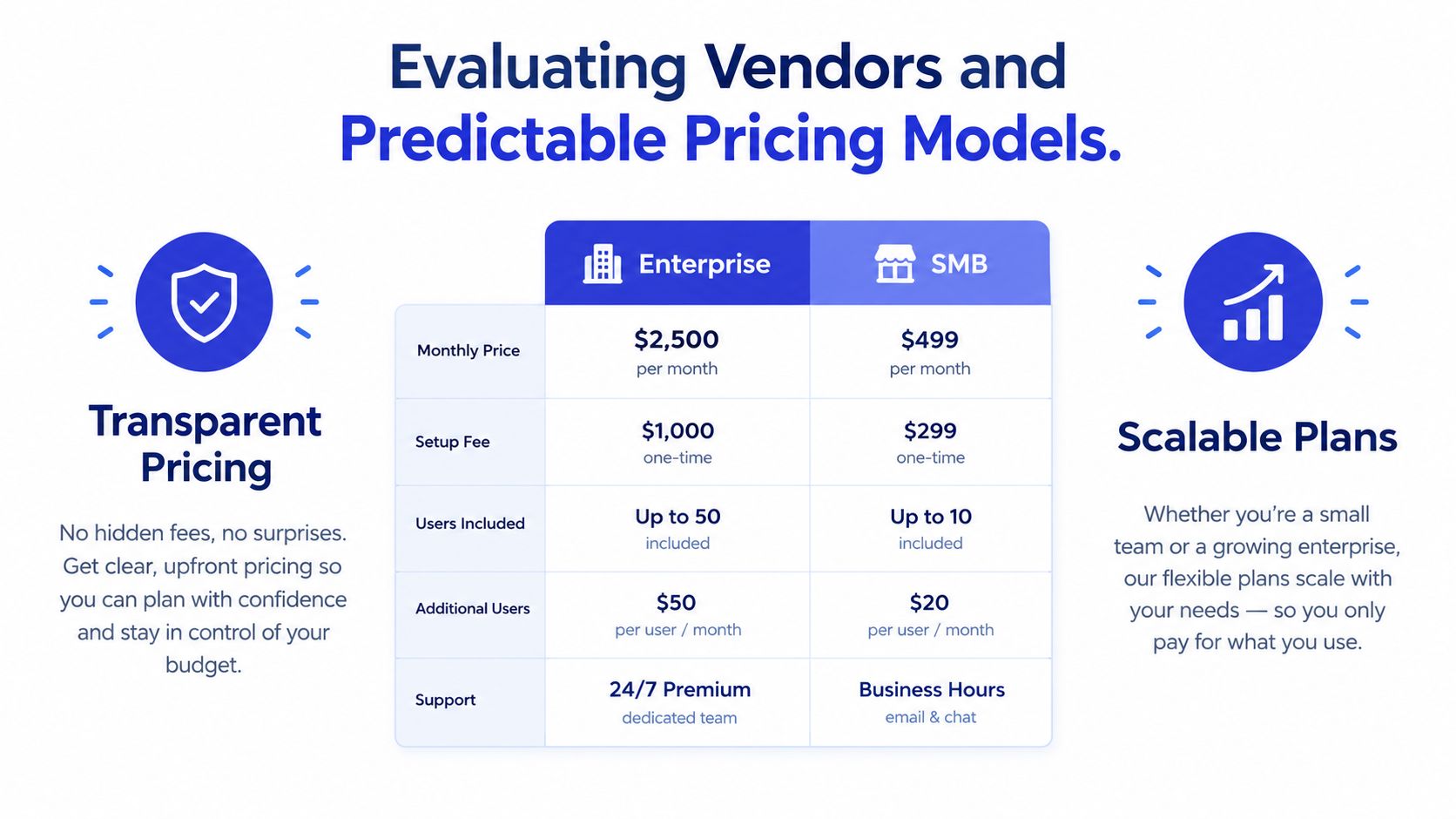
Usage-based enterprise platforms can be appropriate for large, complex environments with procurement, security, and engineering resources. Their flexibility may support detailed integrations, but variable consumption costs and implementation effort can make planning difficult. A predictable subscription model may suit a smaller team that needs to launch quickly, understand its monthly commitment, and expand without rebuilding the workflow.
Compare operational fit, not slogans
Ask vendors to demonstrate the complete path from question to resolution. The demo should include an answer grounded in your content, an ambiguous request, an integration failure, and a human handoff with a useful summary.
Evaluation area | What to verify |
|---|---|
Knowledge control | Can your team approve, update, exclude, and audit the sources used for answers? |
Channel coverage | Can the agent operate across the channels your customers already use? |
Escalation quality | Does the receiving team get intent, identity, transcript, attempted actions, and next steps? |
Brand behavior | Can you set tone, terminology, boundaries, and response behavior without losing accuracy? |
Reporting | Can you separate resolved conversations, escalations, failed answers, and qualified leads? |
Commercial model | Are included messages, users, storage, integrations, and overage rules clear? |
Chatgrow is one option for teams that need custom support agents trained on website, pricing, FAQ, and product content. It supports routine answers, lead qualification, intent recognition, and smart escalation that passes context to a human team. Its published plans start at $39 per month, with message credits, storage, and team access, as described by the publisher, and its pricing information should be checked directly because vendor terms can change.
The right pricing model depends on the cost of uncertainty. If unpredictable usage would prevent a small team from expanding a successful agent, a clear subscription may be preferable. If your operation needs bespoke workflows and deep governance controls, the implementation and integration budget may matter more than the headline plan price.
Measuring Success and Planning Your Next Steps
Count completed resolutions, not just conversations. A useful dashboard should show resolution rate, repeat contacts, escalation context quality, unresolved intent categories, answer accuracy, customer feedback, and sales-qualified lead handoffs.
Run a controlled pilot around one high-volume, low-complexity intent, such as order status or a straightforward pricing question. Establish a human review path before launch, then compare the agent's answers and escalations with the team's expected outcome. Improve the source content and routing rules before adding another intent.
A good pilot answers practical questions:
Did customers reach the right outcome?
Did humans receive enough context to act immediately?
Which questions exposed missing or conflicting knowledge?
Which requests should remain human-led?
Did the workflow create useful sales or support signals?
The strategic objective is not to remove people from service. It is to remove repetitive work from human queues and make every necessary human interaction more informed. AI customer service automation succeeds when it closes the resolution gap, connecting the customer's intent to the right answer, system action, or person.
Chatgrow lets businesses create custom AI support agents trained on their website, pricing, FAQs, and product pages, with lead qualification and smart escalation for cases that need human attention. Visit Chatgrow to explore a focused pilot for your highest-intent support or sales workflow.
More articles from the chatgrow Team