Blog
By
Nelson Uzenabor

A lead contacted within five minutes is about 21 times more likely to qualify than one contacted after 30 minutes, according to the widely cited speed-to-lead benchmark compiled by Ojin's AI sales agent research. That finding changes the business case for AI for lead qualification. The primary value isn't a clever chatbot. It's the ability to capture intent, make a consistent decision, and put the right context in front of a salesperson before the buyer moves on.
The strongest systems treat qualification as a complete operating pipeline. They collect behavioral and firmographic signals, ask useful questions, score fit and readiness, enrich the account record, route the lead according to explicit rules, and give a human enough context to continue the conversation without starting over. The model matters, but the handoff usually matters more.
Table of Contents
Why Speed-to-Lead Drives the Business Case
A five-minute response window determines whether your team reaches a buyer while the problem is still active. The benchmark cited earlier also points to a practical operating gap: leads contacted within five minutes are about 100 times more likely to be reached than leads contacted after 30 minutes. The business case for AI for lead qualification starts with removing that delay, not adding a clever chatbot.
SMBs often lose leads because a form submission waits for review, a rep is on another call, or an assignment rule sends the contact to an unattended queue. By the time someone responds, the prospect may have cooled, answered a competitor, or decided the vendor is not responsive enough. Audit those queues before buying software. If no one owns the next action, better scoring will not fix the pipeline.

Speed improves more than contact rate
Fast qualification also protects pipeline quality. A rep who spends time chasing stale contacts is filling the CRM with uncertain opportunities, weakening forecast confidence, and delaying follow-up with prospects that still show active intent.
AI can respond in seconds, including outside normal business hours. An independent 2025 benchmark across 42 B2B technology deployments reported a median time to qualification of 2 minutes and 47 seconds, while 38% of chatbot-sourced demos occurred after hours (The Starr Conspiracy). Set automation to start when intent appears, then route qualified conversations with enough context for a salesperson to act.
Operational rule: Treat response speed as part of qualification quality. A correct decision made too late can be less valuable than a fast, good-enough decision with a clear human escalation path.
Build the full pipeline, not just a bot
A reliable implementation connects six decisions:
Capture: Identify the lead source and the activity that triggered the inquiry.
Discover: Ask adaptive questions instead of forcing every visitor through the same form.
Score: Compare fit, intent, urgency, and conversation content with the ICP.
Route: Send the lead to the right person, queue, or nurture path.
Handoff: Give the rep the evidence behind the decision and the recommended next action.
Learn: Feed sales outcomes back into the qualification logic.
The advantage is speed plus consistency. A bot that starts conversations but leaves routing unclear creates another inbox. Use AI when it removes delay, preserves context, and makes uncertainty visible enough for a human to resolve.
What AI Lead Qualification Actually Means
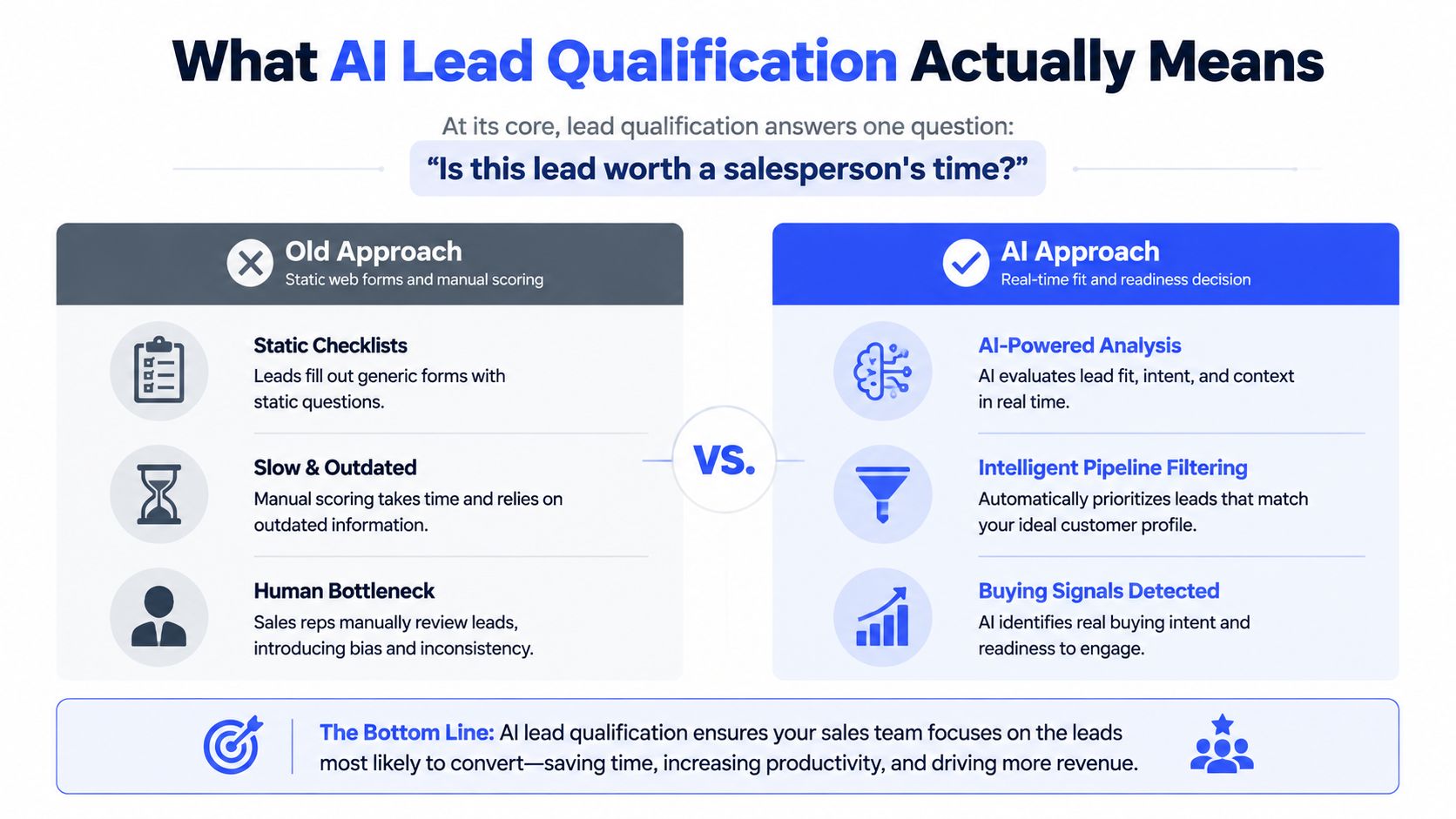
AI lead qualification decides whether a contact merits human sales time, matches the target account profile, and is ready for an active pipeline. The decision rests on three inputs: fit, intent, and timing. A lead may match the ideal customer profile while researching casually. Another may express urgency but lack the authority, use case, or resources needed for a viable deal.
Traditional qualification relies on a static form, manual review, and rules built around company size, job title, or other fixed fields. Reps then repeat a checklist, often using BANT or a similar framework, even when a prospect's answers do not fit the form. Delays follow, and valuable detail in open-ended responses gets overlooked. A practical sales lead qualification guide can help teams define the criteria before automating them.
Conversational AI changes the decision process. It can ask a relevant follow-up when a prospect describes a specific problem, interpret an unstructured answer, detect timing language, and revise the qualification decision as the conversation develops. The value is not a score alone. It is the combination of evidence, routing, and a handoff that gives a salesperson enough context to act.
Use AI as a context layer
The old process behaves like a paper questionnaire at the door. A visitor checks boxes, waits for someone to interpret them, and may never receive a useful reply. An AI-assisted process listens for the buyer's situation, asks the next relevant question, identifies the correct route, and calls in a specialist when judgment is required.
AI qualification is neither general customer support nor a calendar bot. It should not negotiate a complex deal, resolve an emotional complaint, or replace a seller handling a close-ready account. Its job is to create a routing and context layer between buyer intent and sales action.
Set clear boundaries. Let AI collect evidence, classify the opportunity, recommend the next action, and pass uncertainty to a human. Let sales reps handle exceptions, nuanced objections, high-value accounts, and decisions where missing context could change the outcome. That end-to-end pipeline is what turns qualification from automated questioning into a usable sales decision.
The Four Signals AI Uses to Score a Lead
A score is useful only when it combines evidence from different parts of the buyer journey. A pricing-page visit says something different from a company's firmographic fit, and neither tells you as much as a direct statement about an urgent problem. Strong qualification systems therefore combine four signal groups rather than allowing one convenient field to dominate.
Signal Type | What It Captures | Typical Sources | Contribution to Score |
|---|---|---|---|
Behavioral | How actively the prospect researches a solution | Website paths, pricing views, repeat visits, downloads | Indicates engagement and research intensity |
Firmographic | Whether the account resembles the ideal customer profile | CRM records, enrichment data, company and technology records | Measures structural fit |
Intent | Whether the buyer appears to be evaluating a category or vendor | Review activity, competitor research, ad interactions, replies | Adds evidence of active consideration |
Conversational | What the prospect explicitly says about the problem and purchase | Chat, email, forms, call transcripts | Reveals need, urgency, timing, and objections |
Behavioral signals show movement. A visitor who returns to a product page, checks pricing, and downloads implementation material is giving you a sequence, not an isolated event. AI can interpret that sequence and distinguish active research from a single low-intent visit.
Firmographic signals answer whether the account is worth pursuing in the first place. Industry, company characteristics, operating model, existing technology, and role can help determine whether the prospect fits the ICP. Enrichment improves the record, but it also introduces risk when data is stale or incorrectly matched. Don't let a rich-looking profile override direct evidence from the buyer.
Intent signals add external or channel-specific context. Review-site activity, competitor comparisons, ad clicks, and replies to outbound messages can indicate that evaluation is underway. These signals should raise attention, not automatically trigger a sales call. Intent without fit creates false positives.
Conversational signals are often the most valuable because they contain the buyer's own explanation. The system should extract needs, pain points, timing language, budget cues, decision-maker involvement, and sentiment. A prospect saying they need a solution before a specific operational change is more informative than an arbitrary score assigned to a page visit.
The score should produce a confidence level and a reason, not just a number. Salespeople need to know why a lead was prioritized so they can challenge bad assumptions and improve the next decision.
The End-to-End Qualification Workflow
Qualification works best as a sequence of explicit gates. Each gate needs a trigger, an AI action, and a decision that determines what happens next.
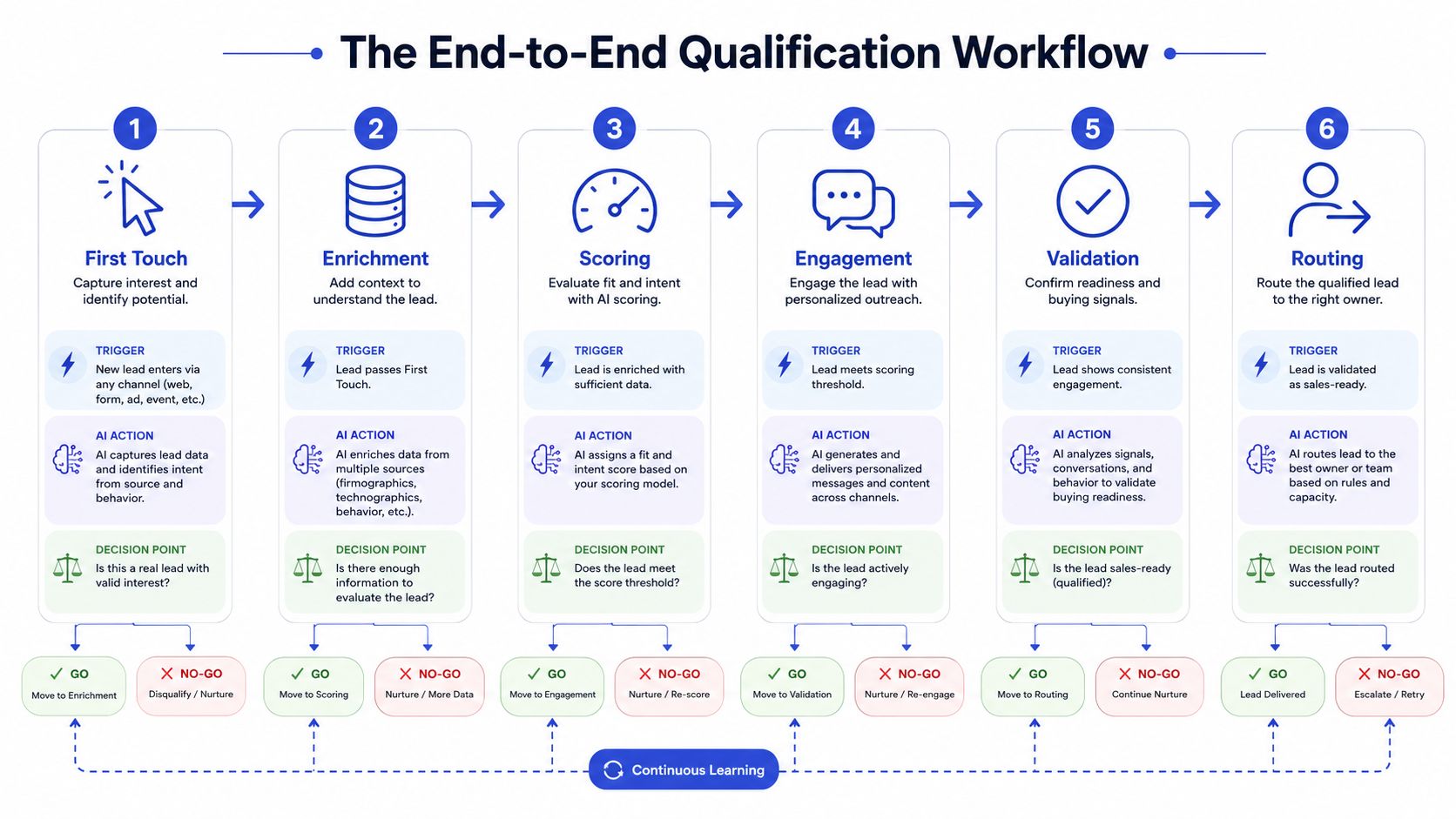
Six gates from first touch to routed rep
First touch: An ad click, form completion, product-page visit, or trial registration creates an event. The system records the source and decides whether the visitor merits immediate engagement.
Conversational discovery: The AI asks only the questions needed to determine fit and readiness. If the visitor has already supplied a detail, it shouldn't ask for that detail again. The go/no-go decision is whether enough information exists to continue, nurture, or escalate.
Signal enrichment: The system connects the contact to account context and fills missing fields where the data is reliable. The decision is whether the record is complete enough for a defensible score.
Scoring: AI compares the combined evidence against the ICP and qualification policy. The output shouldn't be a mysterious grade. It should include confidence, reasons, and uncertainty.
Validation: The system checks for disqualifiers, duplicate records, suspicious submissions, contradictory answers, and missing authority. The decision is whether the lead is sales-ready or requires human review.
Routing and handoff: The CRM receives the score, conversation summary, source, qualification answers, and recommended next action. Routing can depend on territory, specialization, account value, availability, and escalation rules.
A SaaS trial signup might enter from a high-intent product page at 10:00:00. At 10:00:20, the agent asks about the team's use case. By 10:01:30, it captures the workflow problem and identifies the account type. Enrichment completes at 10:02:15, scoring finishes at 10:03:00, and the system routes the record at 10:04:00 with a summary for the assigned rep.
The timestamps are an operating example, not a performance promise. The important design choice is that every stage ends with a decision.
The handoff is the product. If the rep still has to reread the transcript, reconstruct the account, and decide why the lead matters, your automation hasn't finished the job.
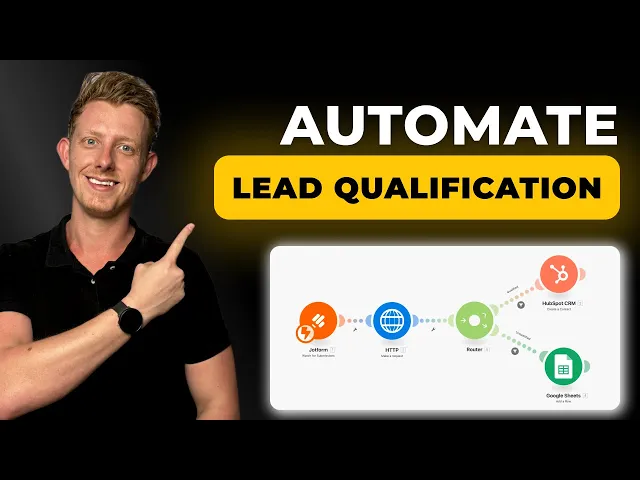
For teams documenting these mechanics, lead qualification automation offers additional workflow context. Use the embedded walkthrough below as a prompt to inspect your own gates, not as a substitute for defining them.
Build, Buy, or Use a Platform
SMBs usually have three realistic deployment paths: build a custom layer, assemble specialist tools, or use a broader platform. The right choice depends less on AI sophistication than on integration ownership, data controls, and the team's ability to maintain decision logic.
Option | Setup time | Monthly cost band | Maintenance | Best for |
|---|---|---|---|---|
Custom build with OpenAI and a CRM | Longest | Variable | High, including prompts, integrations, testing, and governance | Larger teams with dedicated technical ownership |
Point tools such as Qualified, Drift, or 6sense | Moderate | Variable | Moderate to high because systems must stay synchronized | Mid-market teams with specialized requirements |
All-in-one platform such as Chatgrow | Shorter | Predictable plan structure | Lower technical burden, with ongoing workflow review | SMBs that need deployment without development work |
Custom build
A custom build gives you control over prompts, data flow, scoring logic, hosting choices, and CRM behavior. It also makes you responsible for every failure mode, including duplicate records, incomplete context, changing buyer language, permissions, auditability, and model updates.
My recommendation is blunt: custom builds are rarely justified below 200 sales representatives. Smaller teams usually need a dependable workflow sooner, not an internal software project that becomes difficult to maintain after the original builder moves on.
Point tools
Specialist products can be powerful when a specific channel or intent dataset is central to your process. Qualified and Drift can support conversational engagement, while 6sense can contribute account and intent intelligence. The trade-off is integration debt. Each tool may own part of the customer record, which creates synchronization problems and makes it harder to explain a final routing decision.
Mid-market teams can justify this approach when they have an operations owner, clear integration requirements, and enough volume to benefit from specialization. Don't buy multiple tools merely to recreate one qualification workflow across disconnected dashboards.
Platforms
An all-in-one platform reduces setup and maintenance overhead. Chatgrow fits SMB use cases where a business wants custom AI agents trained on its own website and product information, with lead details collected and qualified conversations escalated with context. It also fits teams seeking qualification across channels such as Instagram and WhatsApp without building the workflow from scratch.
For a practical evaluation checklist, compare the lead qualification tools against your actual routing requirements. Under five reps, start with a platform. A mid-market team can add point tools when a clear gap exists. Enterprise teams may build selectively, but they should still buy commodity workflow components rather than owning every layer.
Metrics That Predict Pipeline Impact
A qualification dashboard should prove one business outcome: did the system help sales create better opportunities? Activity metrics matter only when they explain a routing decision, a follow-up action, or pipeline movement.
Start with three revenue-linked measures:
Qualified-lead rate: The share of captured leads that meet the agreed sales-ready definition. Break it down by source, segment, and routing path. A higher rate may reflect stronger targeting, or a threshold that is too loose.
Time-to-qualify: The time from capture to a go, no-go, or human-review decision. This reveals queue delays and shows whether automation improves response speed.
SQL-to-opportunity conversion: The proportion of sales-qualified leads that become genuine opportunities. It is the clearest test of whether routing sends reps prospects worth pursuing.
Industry benchmarks can provide a reference point, but they should not replace your definitions or cohort analysis. Different ICPs, sales cycles, and qualification rules can make the same metric mean very different things. Set your baseline first, then compare performance after changing the model, routing rules, or handoff process.
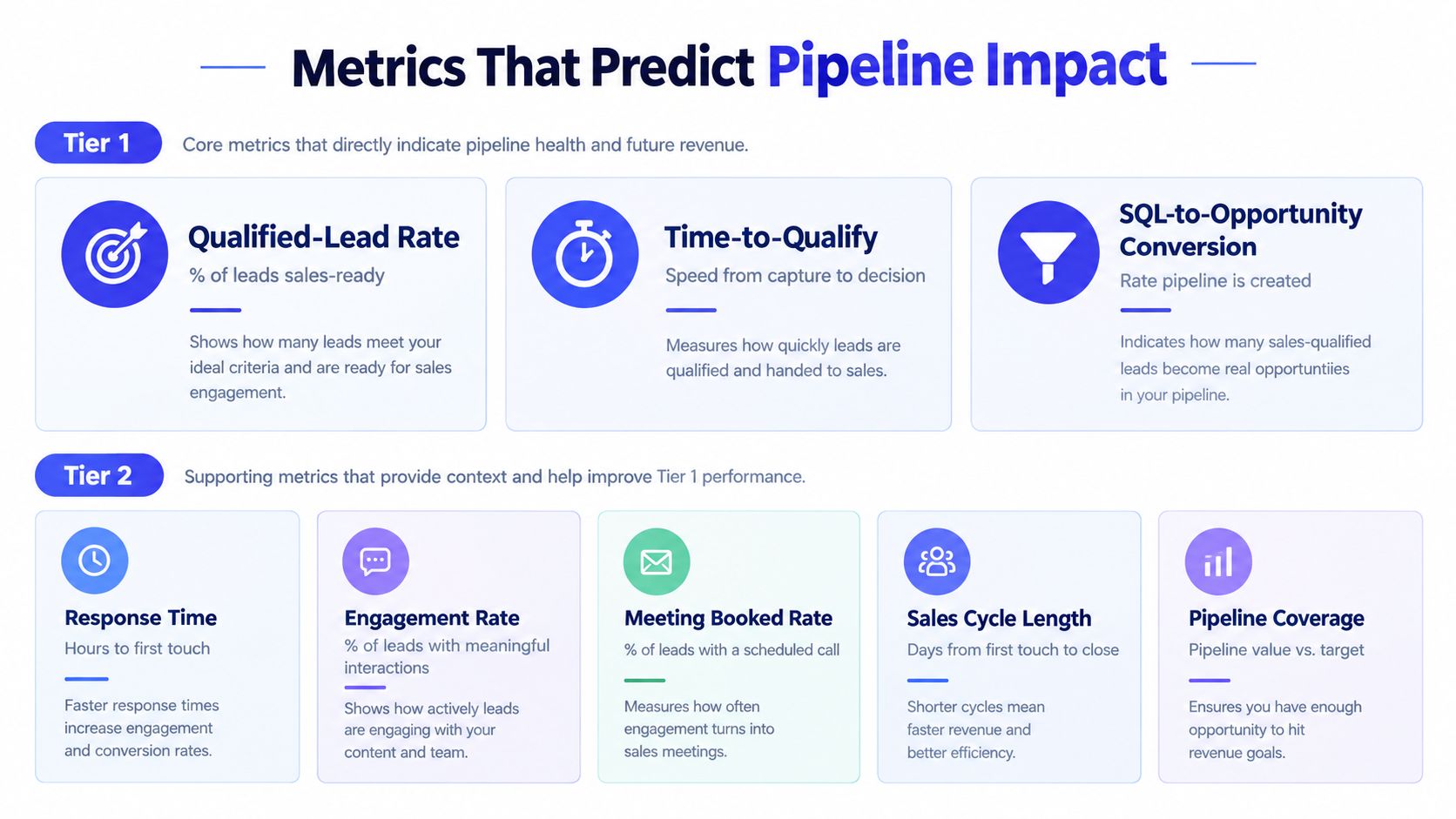
Supporting metrics and metric theater
Supporting measures diagnose where the workflow succeeds or breaks:
Conversation completion rate shows whether visitors reach a decision without abandoning the interaction.
ICP fit rate indicates whether acquisition sources attract the accounts you want.
Cost per qualified lead connects channel spend to usable sales capacity.
Human escalation rate shows how often the system encounters ambiguity, risk, or a request that requires judgment.
Rep acceptance rate measures whether sellers trust the records sent to them.
Raw chat volume, bot deflection rate, and engaged sessions become vanity metrics when they do not influence sales action. A large conversation count can hide weak intent, repetitive support questions, or an escalation path that fails to preserve context.
Diagnostic test: If a metric does not change a routing decision, follow-up action, threshold, or budget decision, remove it from the executive dashboard.
Review results by cohort instead of relying on a blended average. Compare source, account segment, conversation path, and routed representative. If qualified-lead volume rises while SQL-to-opportunity conversion falls, the system is likely admitting too many false positives. Check the transcript, score rationale, and handoff context before changing the model.
Use this automated lead scoring resource to examine the scoring layer, then connect its outputs to opportunity outcomes. Score distribution is a diagnostic, not proof of pipeline impact.
High-Impact Use Cases by Industry
The same qualification engine behaves differently across verticals because buying signals and routing economics change. Ecommerce depends heavily on product intent and service timing. SaaS needs account fit and buying readiness. Agencies must protect specialist capacity from poorly defined requests.
Vertical | Primary Trigger | Key Signal Scored | Routing Destination | Reported Impact |
|---|---|---|---|---|
Ecommerce | Instagram product conversation or high-intent browsing | Product fit, routine or shade need, cart context | Live stylist or qualified nurture | Cost per qualified lead was reported as roughly halved in the supplied example |
SaaS | Trial signup or product-page conversion | ICP fit, use case, account importance, urgency | AE calendar or human escalation | Enterprise leads were escalated to a human within five minutes during business hours in the supplied example |
Agency | Discovery-call request | Budget range, timeline, and decision authority | Strategist or nurture path | Reduced unproductive discovery calls in the supplied example |
Ecommerce
A beauty brand can use an Instagram DM agent to answer questions about shade, routine, and product suitability. The qualification decision isn't whether someone sent a message. It considers the shopper's stated need, product interest, cart context, and whether the question suggests a purchase decision that a live stylist can influence.
High-value browsing activity can route to a stylist, while lower-readiness conversations enter a targeted abandoned-cart or education sequence. The supplied example reports that this pattern cut cost per qualified lead by roughly half. That impact is a reported vignette, not a universal benchmark, so operators should validate it against their own channel and margin data.
SaaS
A 12-person B2B SaaS team can use AI to prescreen trial signups against firmographic criteria, identify the use case, book a demo, and flag enterprise accounts for immediate human attention. The routing rule should distinguish a self-serve trial from a complex account that needs security, procurement, or implementation discussion.
The supplied vignette describes enterprise leads escalating to a human within five minutes during business hours. That rule is more valuable than assigning a high score because it specifies who acts, when they act, and what information they receive.
Agency
An agency should protect strategist time by qualifying discovery requests before booking them. The agent can ask about budget range, timeline, the decision-maker's role, and the business outcome. If those answers are missing or contradictory, the request should go to review rather than directly onto a strategist's calendar.
The goal isn't to reject every imperfect lead. It's to separate a real project conversation from a vague request that needs education first. For agencies, routing quality often matters more than conversation volume.
A 30-Day Rollout and the Human Handoff Rule
Deploy qualification in stages. Do not activate autonomous routing until sales leadership agrees on what “qualified” means. AI will automate disagreement as efficiently as consensus, so the policy must come first.
Week one defines the decision
Audit every lead source, including forms, trials, paid campaigns, social messages, referrals, and inbound email. Sales leadership should approve a written definition covering fit, need, timing, authority, disqualifiers, and required CRM fields.
Deliverable: one qualification policy plus accepted and rejected sample records.
Checkpoint: sales and marketing classify the same sample consistently without inventing separate criteria.
Week two selects evidence
Choose the signals the system may use and mark which ones the team trusts. Separate direct buyer statements from inferred intent. Set provisional thresholds for qualified, nurture, disqualified, and human review.
Deliverable: a score explanation naming the evidence behind every decision.
Checkpoint: a rep can understand why the system routed a lead without reading raw event logs.
Week three configures operations
Build routing rules, CRM fields, ownership logic, notifications, and escalation paths. Test duplicates, missing data, conflicting answers, after-hours submissions, and contacts who request a human immediately.
Deliverable: a handoff record containing the source, fit evidence, conversation summary, objections, urgency, and recommended next action.
Checkpoint: the assigned rep receives one coherent record instead of several disconnected alerts.
Week four runs shadow mode
Let AI score leads and recommend routes while humans retain the official decision. Compare disagreements, inspect false positives and false negatives, and revise prompts, thresholds, and enrichment rules before activation.
Deliverable: a signed launch decision with documented exceptions.
Checkpoint: sales leadership accepts the trade-offs, including the situations that require escalation.
Humans still own judgment
AI should handle first-pass triage, enrichment, basic discovery, and scheduling. Humans should manage high-value negotiations, emotional complaints, ambiguous intent, and complex opportunities involving several stakeholders.
Escalate high-value deals, complaints, and unclear buying situations to a human within five minutes. The speed-to-lead benchmark cited earlier supports that response window. Teams selling above a five-figure annual contract value should use a hybrid model because a wrong interpretation can cost more than the savings from removing one human interaction.
Test the entire ranking pipeline rather than choosing an algorithm by reputation. An experimental comparison found that decision tree and random forest models achieved the strongest accuracy in parts of the evaluation, while a neural network performed best across multiple datasets (Mittweida University study). A separate LLM-based hierarchical scoring study reported AUC 0.8161 and a 39.7% lift in precision among top-ranked leads (arXiv). The practical lesson is clear: improve the ordering of the queue, not only the overall classification score.
Govern the system after launch. A 2026 readiness survey found 66% of leaders rated their own AI fluency as proficient or expert, while only 19% said the same for their organization, and 44% expected AI fluency to become a baseline leadership requirement (ZAI Institute). That gap creates an ongoing operating requirement around data quality, compliance, ownership, and feedback. If the business changes its ICP but never updates the rules or reviews outcomes, accuracy will decline.
Chatgrow lets SMB teams train custom AI agents on website and product information, qualify conversations, capture lead details, and escalate high-intent opportunities with structured context for human follow-up. Visit Chatgrow to review an option for deploying qualification on high-intent pages and channels without building the full pipeline internally.
More articles from the chatgrow Team