Blog
By
Nelson Uzenabor

Your team launches an FAQ chatbot on Monday. By Wednesday, visitors are asking about a pricing page that changed last week, the bot is pulling answers from an old help article, and qualified prospects are being sent into a support queue with no sales context. The dashboard shows more conversations handled, but customers are less satisfied and sales reps trust the chatbot less than they trust a static form.
That outcome isn't a failure of conversational AI alone. It usually means the team treated the bot as a content upload instead of an operational system. How to build an FAQ chatbot depends as much on question harvesting, source ownership, retrieval testing, escalation design, and measurement as it does on the model you choose.
FAQ chatbot building has become mainstream because business adoption has moved beyond experimentation. One 2026 industry summary reports that 91% of businesses with 50 or more employees use AI chatbots, compared with roughly 58% in 2023, while adoption across businesses grew about 4.7 times between 2020 and 2025 (Ringly's 2026 chatbot statistics summary). The practical implication is straightforward: your bot needs to handle repeatable support questions reliably, preserve your brand voice, and recognize when a conversation has shifted from information seeking to buying.
Table of Contents
Why Most FAQ Chatbots Fail Before They Launch
A SaaS team can deploy a bot in three days and still spend the next month repairing the damage. The initial deflection number may look encouraging because the bot intercepts conversations, but that metric doesn't show whether customers received correct answers, whether they had to repeat themselves, or whether a high-intent visitor abandoned the site after a vague reply.
The recurring problems are operational:
Knowledge drift: Product, pricing, refund, and availability documents change, but the bot continues using an outdated source.
Retrieval mismatch: Semantic search finds a passage that sounds relevant but applies to a different plan, region, integration, or customer type.
Brand drift: The answer is technically accurate, yet it sounds unlike the company and creates uncertainty at the exact moment a visitor needs confidence.
Ambiguous handoffs: The bot says “contact support” without collecting context, identifying urgency, or telling the receiving agent what happened.
The answer is a four-stage operating framework: gather, structure, train and respond, then deploy and govern. Each stage needs an exit criterion before the team moves forward. You should know which questions matter, which source owns each answer, what the bot does when retrieval is weak, and how the team will review failures after launch.

Operational rule: Don't approve a launch because the bot can answer a few polished demo questions. Approve it when the team can explain what happens when the answer is missing, outdated, ambiguous, or commercially sensitive.
A useful launch review asks four questions. Have we collected real customer language? Can retrieval be scored against labeled queries? Does every important answer have an owner and freshness rule? Can a customer reach a person without starting over? If any answer is unclear, the bot isn't ready, regardless of how natural its responses sound.
Gathering the Questions Your Customers Actually Ask
Start with customer language, not a blank prompt box. A help-center team usually knows the official wording of a policy, while customers ask “Can I downgrade today without losing access?” or “Why did my invoice change?” Those differences matter because retrieval quality depends on the phrases people use.
Harvest questions from four sources:
Support tickets: Export a representative set from recent conversations and tag each by intent cluster, such as billing, onboarding, integrations, account access, or refunds. Preserve spelling mistakes and informal phrasing. They're useful test inputs later.
Sales calls and discovery notes: Pull objections and “before I sign” questions. Prospects often ask about implementation effort, plan limits, security review, or contract terms before they ever contact support.
Help-center searches: Review searches that return no results or lead to rapid reformulations. A failed internal search often identifies a documentation gap more clearly than a page-view report.
On-site search and communities: Check website search logs, product forums, community discussions, and public support threads. These sources reveal questions customers may never submit as tickets.
For traffic and request analysis, teams can also consult GoReplay's traffic replay tool documentation to understand how replayed application traffic can support investigation and testing workflows. Use it as an engineering aid, not as a substitute for support and sales context.
Deduplication turns noisy inputs into maintainable answers. Suppose three raw questions appear:
“How do I change my plan?”
“Can I downgrade mid-cycle?”
“Where do I update billing frequency?”
They can map to one canonical FAQ: “How do I change or downgrade my plan mid-cycle?” Keep the three original phrasings as retrieval examples, then connect them to one approved answer. This prevents the knowledge base from accumulating near-duplicate responses that drift apart.
Prioritize commercial importance, not volume alone
A typo question that appears frequently may be easy to answer and have little business impact. A pricing-change question asked less often may influence expansion, retention, or purchase decisions. Rank each canonical FAQ by frequency multiplied by revenue impact, then add operational urgency and answer confidence.
Source | Typical Volume | Revenue Signal | Suggested Weight |
|---|---|---|---|
Support tickets | High | Retention, satisfaction, cost to serve | High |
Sales calls | Medium | Objections, buying intent, deal progression | Very high |
Help-center searches | Variable | Documentation gaps, self-service demand | High |
On-site search | Variable | Page-level intent and conversion friction | High |
Community forums | Variable | Emerging issues and product confusion | Medium |
The output should be more useful than a question list. Create a record for every canonical FAQ with the owner, source documents, intent cluster, priority, and confidence rating. If nobody owns the answer, you've found a governance problem before it reaches production.
Structuring Knowledge So Retrieval Actually Works
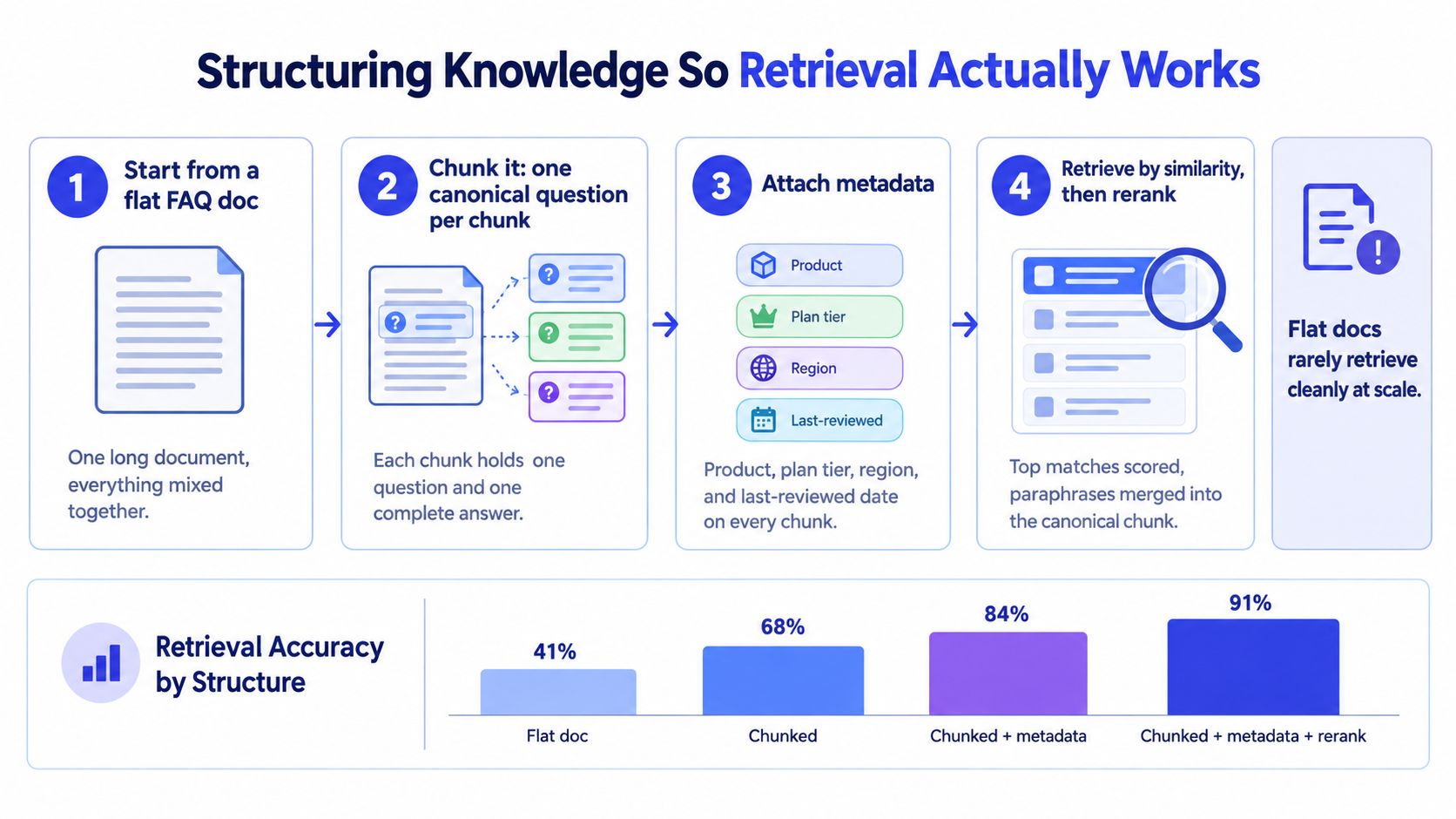
A flat FAQ document may look tidy to a human while confusing a retrieval system. Long pages often combine plans, exceptions, regions, and policy dates, so a passage can match the wording but still apply to the wrong customer.
Build the knowledge layer from complete, independently useful chunks. A practical default is one canonical question per chunk, with its full answer stored alongside it. Keep conditions and exceptions in the same chunk, attach metadata, and avoid fragments that separate a rule from the situation that limits it.
Useful metadata includes:
Product or feature
Plan tier
Region or market
Customer type
Source document identifier
Owning team or email
Last-verified date
Effective date, when applicable
Sensitivity or escalation category
These fields let the system filter stale or inapplicable content before ranking passages. They also let an operator trace an answer to its source and find the person responsible for updating it. Teams creating a broader documentation system can consult this guide to building a knowledge base. The platform matters less than the operating rule: every answer needs a clear source, an owner, and a review point.
Build a golden-query set
Create a labeled golden query set from the questions gathered during harvesting. The engineering guidance in Heeya's knowledge-base engineering guide recommends using about 50 to 100 representative questions, mapping each manually to the correct source chunk or chunks, and evaluating retrieval before generation. It also recommends tracking precision@5, recall@5, MRR, containment rate, and faithfulness, with precision@5 above 0.8 as a practical production bar.
The exact size matters less than repeatable testing. Run the benchmark at launch, after major content changes, and during scheduled reviews. Compare failures by product, plan, region, and intent so the team can fix missing content, poor chunk boundaries, or overly broad filters. A knowledge layer that cannot be scored against known questions is not ready for customer-facing answers.
Fallback behavior belongs in the architecture, not in a hopeful prompt. If no source chunk clears the confidence threshold, the bot should ask a clarifying question, escalate with conversation context, or state that it cannot verify the answer. A plausible guess can increase containment briefly while creating incorrect support and qualification outcomes.
Training Intents and Crafting On-Brand Responses
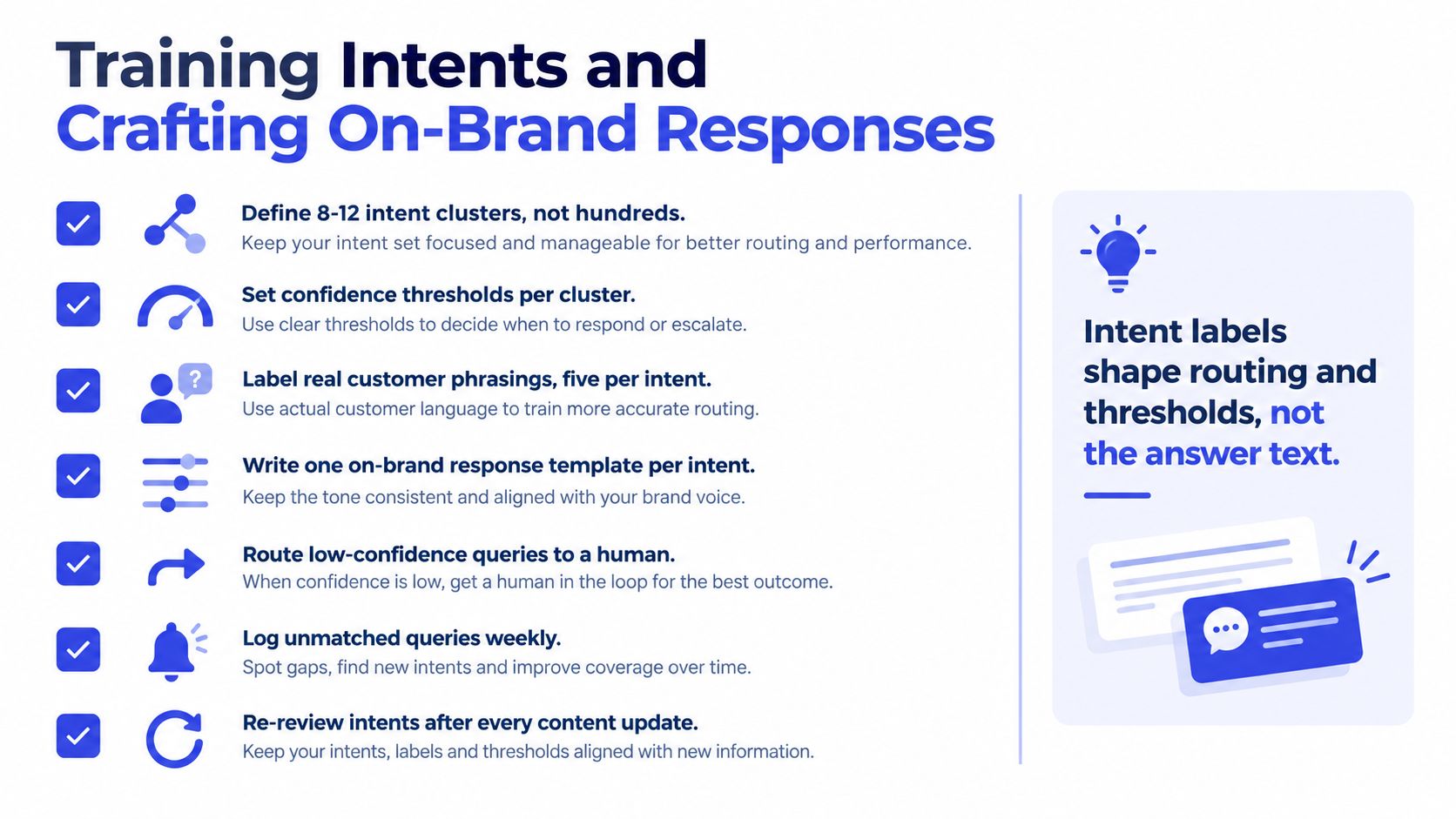
Intent labels should organize routing and confidence rules. They shouldn't become a sprawling taxonomy that tries to predict every sentence a customer might write.
Begin with 8 to 12 high-traffic intent clusters, such as Pricing, Refunds, Onboarding, Integrations, Account Access, Billing, Security, Product Usage, and Lead Qualification. Add examples from real conversations to each intent, including paraphrases, shorthand, and common misspellings. The classification layer then helps the system select the right retrieval scope, escalation path, and qualification flow.
A response template should be more constrained than the underlying conversation. Use a consistent pattern:
Lead with the direct answer.
Add one sentence of relevant context.
Link to the authoritative document.
End with a useful next step or escalation prompt.
For example, a billing response can answer the plan-change question first, clarify whether the change takes effect immediately or at renewal if the source confirms it, link to the billing article, and ask whether the visitor wants help from the account team. The template gives the model room to respond naturally without allowing every answer to develop its own structure.
Separate answerable questions from restricted ones
Create explicit do-not-answer categories for legal, medical, security-sensitive, and account-specific requests. The bot should explain the boundary briefly and route the conversation to a trained human or approved workflow. A security question may require identity verification. A refund request may need account lookup. Treating both as ordinary FAQ retrieval creates avoidable risk.
Entity detection improves disambiguation. Capture details such as order number, plan tier, product name, region, or account type before retrieving an answer. “Can I add users?” means something different for a trial account than for an enterprise plan, and a region-specific policy shouldn't be answered from a general page.
Lead qualification needs its own structured path. Ask for the relevant use case, budget range, and timeline, then route the conversation when buying intent becomes clear. In a Chatgrow workflow, for example, the agent can tag the conversation with intent and budget range, create a CRM contact or ticket, notify a sales channel, and send a follow-up sequence. Treat those as workflow actions that need testing, not as claims that every chatbot platform supports.
Use a tone checklist before publishing any new template:
First-person plural where appropriate
Short, readable sentences
Direct answers before background
Approved terminology for products and plans
Forbidden words and unsupported promises
Clear human handoff language
The chatbot training workflow guide provides a related implementation reference. The principle is universal: brand voice needs a review gate, not just a persona field.
Testing the Bot Before Real Visitors See It
A convincing preview can still hide unsafe retrieval, weak handoffs, and poor qualification. Before launch, replay historical questions in read-only mode and compare each response with an answer rubric. Label every result as correct, partial, hallucinated, or appropriately declined. Inspect the retrieved source alongside the wording, because a fluent response may cite the wrong document.
Use four test layers:
Historical replay: Run a representative set of real support queries against the pre-production bot and grade each answer against the expected result. Follow the earlier knowledge-evaluation guidance for how to structure the review.
Adversarial probes: Test typos, multilingual inputs, ambiguous questions, prompt-injection attempts such as “ignore previous instructions,” and out-of-scope pricing or account requests.
Golden-query regression: Keep paraphrases for every important FAQ and rerun them after changes to source content, chunking, prompts, or model settings.
Human low-confidence review: Send responses below the configured threshold to a reviewer. In qualification flows, the reviewer should confirm that a lead is ready for CRM submission instead of trusting an uncertain classification.
Test Layer | What It Catches | Pass Threshold |
|---|---|---|
Historical replay | Incorrect answers and weak retrieval | Rubric review completed for every query |
Adversarial probes | Injection, ambiguity, and boundary failures | No unresolved critical failure |
Golden-query regression | Quality regressions after changes | Team-defined release gate |
Human low-confidence review | Risky answers and poor qualification | Every flagged response reviewed |
Set launch gates before testing begins. The testing guidance calls for a replay-set hallucination rate under 2%, zero PII leaks, a verified escalation path, and functioning analytics events. A separate engineering benchmark recommends precision@5 above 0.8 for production retrieval, while the comparative retrieval study shows that reported FAQ results vary by method and similarity threshold. One semantic SBERT approach reported 79.2% accuracy, 81.7% precision, 96.3% recall, and 88.4% F1 at a similarity threshold of 0.5. A hybrid Jaccard and K-NN approach reported 87% accuracy, 86% precision, 85% recall, and 85% F1.
Those figures are benchmarks, not promises for your bot. Build a labeled test set from your own support and sales conversations, then tune thresholds against the cost of missed answers and unsafe answers. Use the chatbot testing guide as a practical reference, and record the release decision, unresolved risks, owner, and retest date. That record turns testing into ongoing governance rather than a one-time launch check.
Deploying to Your Site and Messaging Channels
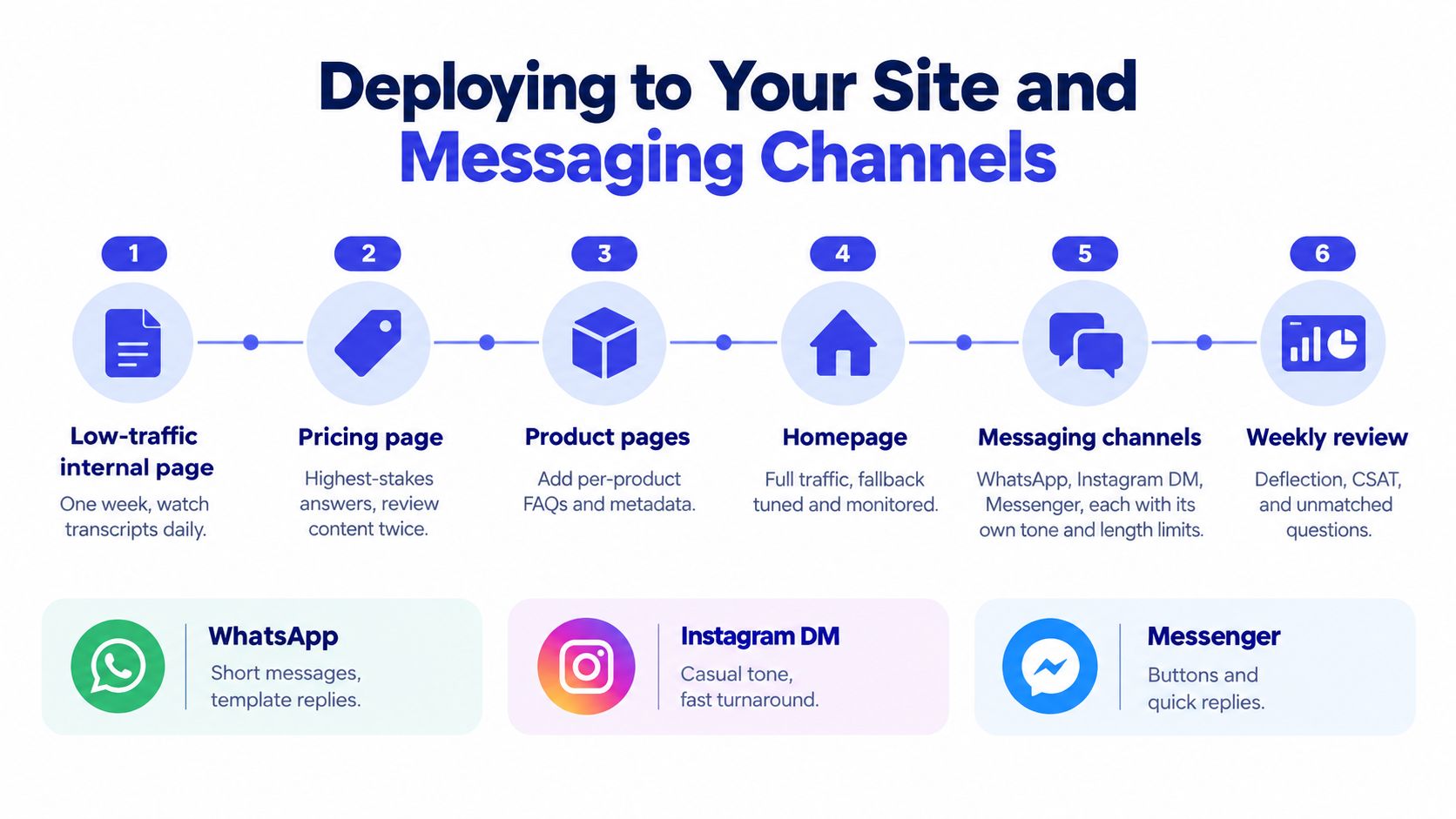
Rollout order affects the quality of your feedback. Put the bot on a low-traffic internal or help page first, inspect transcripts, and fix retrieval issues before exposing it to high-intent visitors. Then move to pricing pages, product pages, the homepage, and finally messaging channels such as WhatsApp, Instagram Direct Messages, and Messenger.
Each surface needs its own interaction rules. A chat bubble works well when visitors need optional help without losing page context. An inline assistant fits a help center where the visitor is already looking for an answer. A full-page experience can support longer troubleshooting, but it changes the page journey and should be evaluated separately from a lightweight widget.
Don't assume the same response works everywhere. Website visitors can read linked documentation and longer explanations. Messaging users usually need shorter replies, quick actions, and a clear way to request a person. Keep channel-specific policies for tone, message length, buttons, and escalation.
On high-intent pages, trigger behavior deserves careful tuning. A delayed proactive prompt can help a visitor who appears stuck, but an intrusive prompt can interrupt evaluation. A persistent launcher is usually more appropriate on mobile, where screen space is limited. Avoid deploying without explicit human handoff on checkout or account-login pages, where errors can affect payment, access, or personal data.
A qualified conversation should create a usable sales handoff. The workflow should preserve the intent, relevant answers, captured qualification details, and conversation summary. Apply rate limits and abuse controls so repeated prompts or injection attempts don't consume resources or force the agent into unsafe behavior.
Use a controlled rollout calendar
A practical rollout calendar can assign an initial period to the internal page, then activate pricing, product, homepage, and messaging surfaces in sequence. Each morning, review containment, answer quality, escalations, unmatched queries, and lead-routing events for the pages already enabled. Don't turn on every channel because the embed works.
Measuring, Iterating, and Governing the Bot Over Time
Post-launch work is where most FAQ chatbot programs either become dependable or lose trust. Pull unresolved and low-confidence conversations every week, cluster them by intent, and send each cluster to a named documentation owner. The owner should decide whether the fix belongs in the source document, the retrieval configuration, the response template, or the escalation workflow.
Governance needs written rules:
Source of truth: Identify which page or system controls pricing, policy, product, and account answers.
Ownership: Assign a team or person to approve changes and resolve conflicts.
Freshness: Define when a source must be reviewed again, especially after a product or policy change.
Escalation: Specify which subjects require a human and what information the bot must collect first.
Change loop: Rerun the golden-query benchmark after material content or configuration changes.
A 2026 guide on FAQ chatbot operations emphasizes cleaning contradictions, removing outdated pages, auditing unanswered questions, and assigning explicit document ownership. Its recommendation to treat the bot as a living support system, with regular gap review rather than a one-time launch, matches what operations teams see in practice (the FAQ chatbot build and governance guide).
Measure business outcomes, not conversation volume
Containment and deflection are useful only when paired with quality and commercial measures. A bot can reduce apparent ticket volume by making customers give up, or it can attract conversations that never had a chance of becoming tickets. That's why metrics need to be read together.
Metric | What It Measures | Risk of Tracking Alone |
|---|---|---|
Containment rate | Conversations ending without human intervention | May reward premature closure |
Deflection | Potential tickets avoided | Can hide abandonment or repeated contact |
Answer accuracy | Whether the response matches the approved source | May ignore tone and usefulness |
Escalation quality | Whether the handoff includes the right context | A high rate can still produce poor transfers |
CSAT | Customer-reported experience | Low response volume can distort interpretation |
Lead-to-opportunity conversion | Whether qualified conversations progress commercially | Depends on sales follow-up and attribution |
Revenue influenced | Commercial value associated with bot-assisted journeys | Attribution can over-credit the bot |
Cost per resolved ticket | Efficiency of resolving a support issue | Needs a reliable definition of “resolved” |
Independent guidance on FAQ chatbot measurement stresses containment, answer accuracy, escalation quality, and conversation-level feedback, rather than treating launch as the definition of success (Elfsight's FAQ chatbot guidance). In my view, cost per resolved ticket is the cleanest efficiency benchmark when the resolution definition is consistent. For sales use cases, pair it with lead-to-opportunity conversion and revenue influenced, then inspect transcripts to confirm that the chatbot contributed useful information rather than merely appearing before a purchase.
The first operating cycle should establish a baseline, the next should fix the largest unanswered clusters, and the following cycle should verify that fixes improved retrieval and handoff quality. Configure automatic review queues for low-confidence answers, and route buying-intent conversations to sales while the context is still fresh. The bot should get more reliable because the team operates it deliberately, not because the model is expected to improve on its own.
Chatgrow provides tools for training AI customer-service agents on website, pricing, FAQ, and product content, then deploying them for support and lead qualification across customer-facing channels. If you're ready to turn your FAQ bot into a governed support and qualification workflow, visit Chatgrow and map your first knowledge sources, escalation rules, and high-intent page rollout.
More articles from the chatgrow Team