Blog
By
Nelson Uzenabor
At 11:43 PM, a high-intent visitor lands on your pricing page and asks whether implementation support is included. If your live chat team has gone offline, the visitor may leave before anyone replies. If a rigid chatbot gives the wrong answer, the visitor may leave even faster.
That scenario exposes the flaw in the usual live chat vs chatbot debate. An SMB founder isn't really choosing between two website widgets. They're deciding which conversations deserve scarce human attention and which can be handled automatically, accurately, and at any hour.
Live chat connects buyers with people who can interpret context, handle objections, and recover trust. Chatbots provide immediate coverage for routine questions, lead capture, and first-line triage. Modern AI agents can do more than follow a decision tree, but they still need clear knowledge sources, boundaries, and escalation rules.
The practical answer is conversation routing. Use automation where speed, consistency, and availability matter most. Reserve human agents for ambiguity, emotion, commercial risk, and customers whose value justifies personal attention. This approach reduces the false choice between hiring more support staff and deploying automation without supervision.
Table of Contents
What Live Chat and Chatbots Actually Are
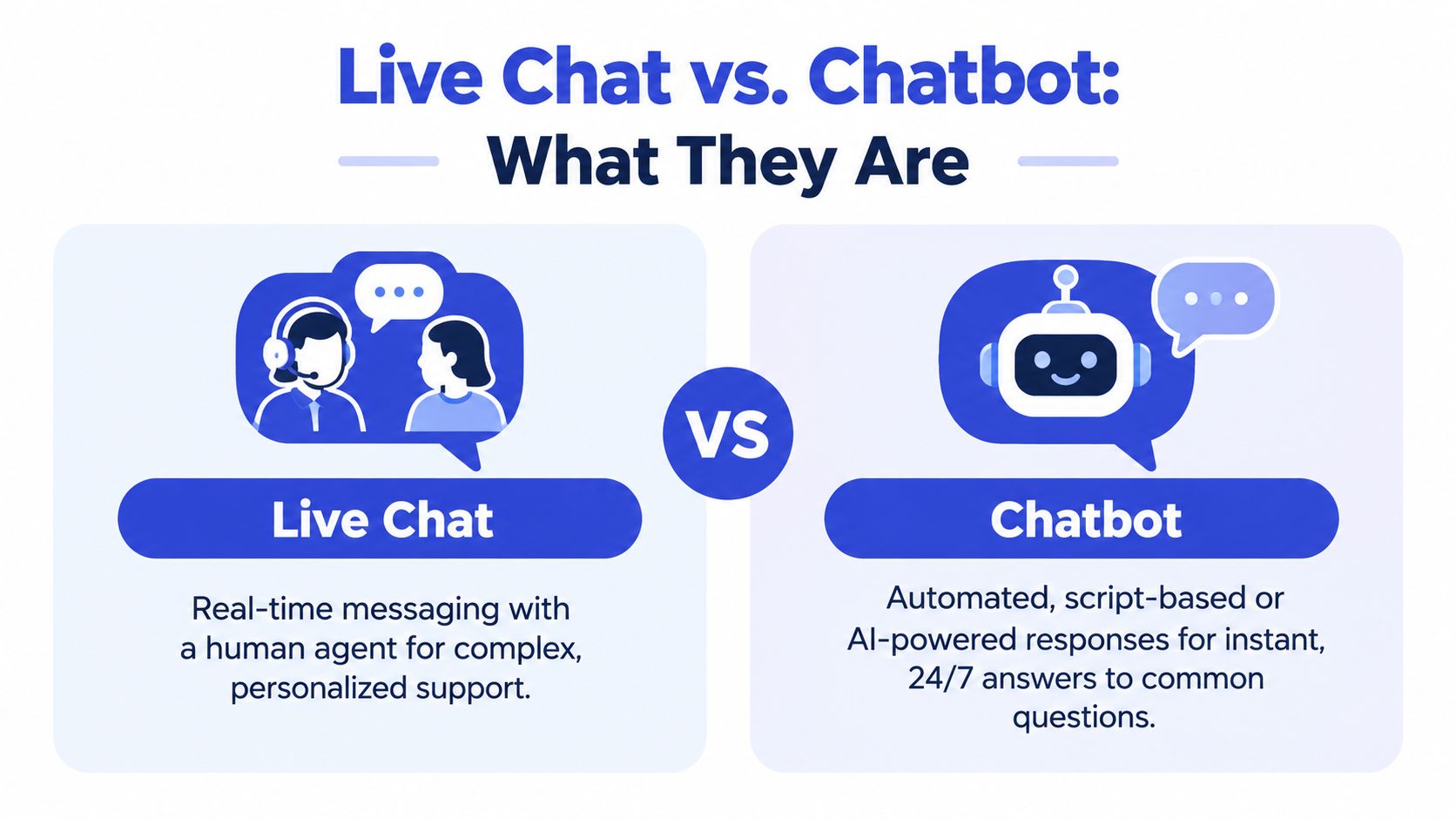
Live chat is real-time messaging with a human agent. The agent works from a shared inbox or customer-service dashboard, answers questions, checks account or order information, and may transfer the conversation to another team member. It's staffed support delivered through a faster, more convenient interface than email or phone.
A chatbot is an automated conversational interface. It may use fixed rules, scripted flows, or AI to interpret questions and produce replies. Basic bots answer predefined FAQs. More capable AI chatbots can use website content, product documentation, policies, and FAQs to answer contextual questions, qualify leads, schedule meetings, or route support requests.
The distinction matters because the operating model changes. Live chat requires staffing, training, scheduling, and quality control. A chatbot requires reliable knowledge, careful intent design, testing, monitoring, and a safe path to a human. Teams evaluating acquisition impact should also track LiveChat lead source origin so conversations can be connected to the pages and campaigns that produced them.
Dimension | Live Chat | Chatbot |
|---|---|---|
Primary operator | Human agent | Rules engine or AI agent |
Availability | Depends on staffing | Can operate continuously |
Best fit | Complex, sensitive, or high-value conversations | Repetitive questions, triage, and lead capture |
Scalability | Limited by agent capacity | Can handle many conversations simultaneously |
Main risk | Delays, inconsistent coverage, and staffing cost | Incorrect answers, poor context, and frustrating handoffs |
Core requirement | Trained agents and clear schedules | Accurate knowledge and escalation controls |
A useful guide to live chat support can help teams map the operational requirements before choosing a vendor. The important point is simple: live chat is a human service channel, while a chatbot is an automation layer. The quality of either depends on how well it fits the intent behind each conversation.
How to Choose Between Live Chat and Chatbots
Start with four questions: How much conversation volume do you handle? How difficult are the questions? What level of operating cost can you tolerate? How quickly and how often must you respond? These questions produce a better decision than comparing feature lists.
1. Assess conversation volume
Low or unpredictable volume usually favors live chat. If agents can respond without creating a queue, human interaction may deliver more value than automation setup.
High volume with repetitive questions favors a chatbot. Shipping status, return policies, pricing basics, appointment availability, and password guidance are structured intents. Automating them keeps agents available for conversations that require judgment.
2. Classify issue complexity
Simple, well-documented questions belong in automation. Complex technical problems, billing disputes, unusual account situations, and emotionally charged complaints should reach a person quickly.
Don't judge complexity only by the wording of the first message. “Can I cancel?” might be a simple policy question, or it might involve a failed renewal, a service outage, or a frustrated long-term customer. The routing system needs to detect account context and risk, not just keywords.
3. Decide what cost you're optimizing
Chatbots reduce the need to assign an agent to every repetitive interaction, but they aren't free of operational work. Someone must maintain the knowledge base, review failed answers, test new policies, and inspect escalations.
Live chat carries direct staffing costs and requires coverage planning. It remains sensible when each conversation has meaningful commercial value or when a poor answer could damage retention. The right comparison is not software price versus wages. It's total operating cost against the value of correctly resolved conversations.
4. Set the response expectation
If customers need an answer outside business hours, automation provides the practical first response. If the answer requires empathy or negotiation, instant automation isn't enough. A fast wrong answer creates more work than a slower accurate one.
Use this decision table as a quick classification tool:
Criterion | Threshold | Recommended Path |
|---|---|---|
Conversation volume | High and repetitive | Chatbot first |
Conversation volume | Low or unpredictable | Live chat |
Issue complexity | Clear FAQ or policy answer | Chatbot |
Issue complexity | Unique, sensitive, or technical | Live chat |
Cost tolerance | Limited staffing capacity | Chatbot for routine intents |
Cost tolerance | High value per conversation | Live chat for priority visitors |
Responsiveness need | Continuous coverage required | Chatbot with escalation |
Responsiveness need | Business-hours coverage is acceptable | Live chat |
If two or more criteria point in different directions, don't force a single-channel decision. Start with automation for low-risk intents and add human routing where the commercial or emotional stakes rise.
Performance, Cost, and Conversion Comparison
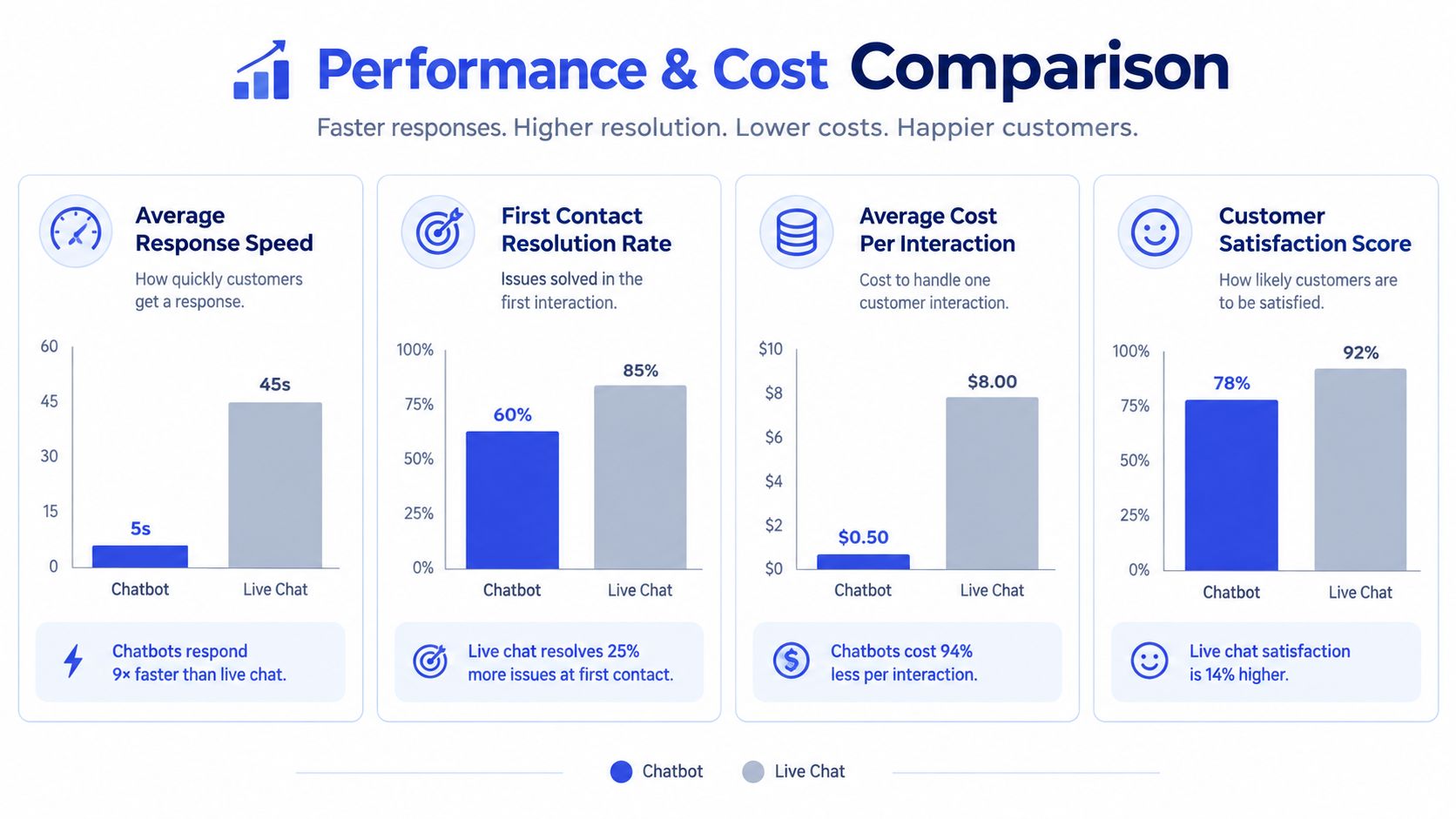
The right question is which conversations deserve human attention. A 2026 benchmark covering more than 220 million live chat interactions reported that AI agents handled 75.3% of chats, improved satisfaction by 9.1%, and achieved 92.6% CSAT on chatbot-to-agent handoffs (Comm100 Live Chat Benchmark Report). For an SMB, that supports a clear routing rule: let automation absorb predictable demand, then send uncertainty, buying intent, and service risk to people.
A separate 2026 analysis found that AI chatbots fully resolved 44.8% of customer-service conversations without human involvement. Treat that figure as an upper bound for a well-documented knowledge base, not a default expectation for a new deployment. Your results depend on content quality, intent design, escalation rules, and whether the bot can access the information required to answer accurately.
Lead qualification adds another practical consideration. One controlled comparison reported qualified-lead conversion of roughly 3.2% for AI chatbots, compared with 2.7% for live chat and 0.2% for contact forms (Conferbot's chatbot comparison). The result supports using a bot for immediate qualification, not handing every sales conversation to automation. Route high-fit prospects to an agent once questions shift from basic qualification to objections, implementation, or commercial terms.
What each channel costs operationally
Live chat carries recurring staffing costs. Coverage requires agent time, management, training, quality review, and scheduling. The return is judgment. A capable agent can clarify ambiguity, address objections, and protect a valuable relationship when a scripted response would lose momentum.
Chatbot costs appear earlier and in different places. Setup requires content preparation, integrations, testing, monitoring, and regular updates. After deployment, automation can handle routine demand without assigning a person to every exchange. Review failure transcripts before expanding the bot's scope.
Market forecasts explain the investment, but they do not establish an SMB business case. The AI chatbot market was estimated at about $9.08 billion in 2025 and projected to reach $18.27 billion by 2028. Another forecast placed the global chatbot market at $15.5 billion by 2028. Treat these projections as evidence of supplier and buyer interest, not as proof that automation will reduce your costs.
The metric founders should watch
Track qualified conversations, escalation accuracy, assisted revenue, resolution quality, repeat contacts, and customer satisfaction after handoff. A bot that resolves simple questions but sends weak leads to sales creates hidden costs. An agent who handles fewer conversations may produce more revenue by rescuing high-value opportunities.
For practical setup guidance, review this resource on an AI chatbot for customer support. Start with low-risk intents, measure handoff quality, and expand automation only where the conversion and service data support it.
Real-World Use Cases Where Each Option Wins
The right tool depends on the visitor's intent, not the industry label. A clinic, SaaS company, store, or consultancy can need different routing on different pages.

Healthcare clinic
A visitor asks about appointment availability after hours. A trained chatbot can explain appointment types, collect preferred dates, provide preparation instructions, and route urgent or sensitive matters according to the clinic's policy. It shouldn't improvise medical guidance or make promises outside its approved knowledge.
The best configuration keeps the bot focused on administration. Human staff take over when the visitor describes a situation requiring clinical judgment, privacy-sensitive assistance, or reassurance.
SaaS pricing page
A prospect asks whether a plan includes a specific integration, then raises an objection about onboarding. The first question may be answered from product documentation. The objection deserves a live sales conversation because the prospect is evaluating fit, risk, and implementation effort.
Route visitors from pricing, enterprise, or demo pages more aggressively than visitors browsing a generic help article. Page context is a strong signal of commercial intent, especially when the visitor asks about security, migration, contract terms, or implementation.
E-commerce store
A customer asks where an order is and whether returns are free. These are classic automation intents. The chatbot can provide policy information or request an order identifier, then escalate exceptions such as damaged goods, missed delivery, or a disputed refund.
Keep the human queue for cases where a policy answer isn't enough. A bot should not repeatedly restate a returns page while the customer is explaining that the item arrived defective.
B2B consultancy
A warm visitor asks whether your team has experience with a specialized transformation project. Live chat is usually the better first touch. The visitor isn't looking for a generic FAQ. They're testing expertise, credibility, and whether your firm understands their situation.
A chatbot can still collect company details and project scope before handoff. But if the visitor signals urgency, budget authority, or a complex business problem, route directly to a senior human rather than making them pass through a long qualification script.
Implementation Checklist for Live Chat and Chatbots
Choosing a channel is only useful if your team can operate it reliably. Deploy the smallest workable system, then improve it from real conversations.
Live chat readiness
Assign ownership. Name the team responsible for monitoring, responding, and escalating conversations. Completion means every operating hour has a clear owner.
Create response standards. Define tone, prohibited promises, refund authority, and escalation conditions. Agents should know when they can solve an issue and when they must involve billing, engineering, or management.
Connect customer context. Integrate the chat workspace with your CRM, help desk, order system, or scheduling tool where appropriate. Agents shouldn't ask customers for information your team already has access to.
Train with real scenarios. Practice pricing objections, angry customers, technical uncertainty, and handoffs. Readiness comes from observed responses, not a completed software setup.
Review the first operating period. Inspect unanswered chats, repeated questions, escalations, and conversations that ended without a clear next step. Turn recurring issues into documentation or automation candidates.
Chatbot readiness
Choose authoritative knowledge. Start with current pricing, policies, product pages, FAQs, and support documentation. Remove conflicting or outdated instructions before connecting them to the bot.
Map intents. List the questions customers ask and group them into answerable, collectable, and escalation-required categories. Keep the initial scope narrow enough to test.
Set boundaries. Tell the agent what it must not claim, which actions require approval, and when it should say that a human needs to review the issue. Safe refusal is better than confident invention.
Design the handoff. Capture the visitor's question, relevant details, contact information, and conversation history before transferring to an agent. A human should receive a usable summary, not a blank inbox notification.
Test failure paths. Try ambiguous questions, contradictory requests, unsupported topics, frustrated language, and policy exceptions. Launch only after the bot can exit gracefully.
Review outcomes. Monitor unanswered intents, correction requests, escalations, qualified leads, and post-handoff satisfaction. Update the knowledge source when the same failure appears repeatedly.
Don't launch a chatbot because the tool is easy to embed. Don't launch live chat without deciding who answers during busy periods. Both systems need ownership, measurement, and a clear definition of a successful conversation.
Hybrid Strategies and Next Steps for SMBs
Most SMBs should build a hybrid routing model, but not the vague version where every chat starts with a bot and every failure lands on an overloaded agent. The system should decide based on intent, page context, urgency, customer value, and the bot's confidence.
Route routine work to automation
Keep automation in control when the visitor asks for a documented, low-risk answer:
Shipping, delivery, and return policies
Store hours and appointment logistics
Product specifications already covered in approved content
Password or account guidance that doesn't require sensitive judgment
Basic plan comparisons
Lead capture when the visitor hasn't shown strong buying intent
The bot should answer directly, cite the relevant policy or product information within the conversation where possible, and offer a human option without trapping the visitor.
Escalate high-risk conversations early
Send the conversation to a human when the visitor:
Raises a billing dispute, cancellation problem, or service failure
Requests an exception to a policy
Expresses frustration, urgency, or confusion after an unsuccessful answer
Asks about security, compliance, legal terms, or sensitive personal information
Shows buying intent on a pricing, demo, checkout, or enterprise page
Represents a high-value account or an existing customer with a serious issue
A human handoff should preserve context. Pass the original question, detected intent, relevant customer details, pages viewed where available, answers already given, and the reason for escalation. Tools such as real-time agent assist can help agents work from that context instead of restarting discovery.
Use a phased rollout
Phase one, contain low-risk demand. Automate a small set of repetitive intents from your strongest documentation. Keep human takeover visible and review every escalation.
Phase two, add qualification. Ask only the questions sales or support needs. Route based on product interest, urgency, account status, and page context. Compare qualified conversations, not just conversation totals.
Phase three, expand carefully. Add more intents only after reviewing errors and handoff quality. Introduce automation to off-hours traffic, then adjust routing for high-intent pages where a human can protect conversion.
Phase four, optimize the boundary. Move stable, repetitive tasks into automation. Move ambiguous or commercially important tasks toward people. Review the boundary whenever pricing, policies, products, or staffing changes.
The operating principle is straightforward:
Automate the predictable. Escalate the consequential.
Don't ask whether live chat or chatbot is universally better. Ask which system should handle each intent, what information it needs, and what happens when confidence falls. That routing decision will determine conversion quality, support workload, and customer trust more than the chat label on your website.
Chatgrow lets SMBs train AI support agents on website content, pricing, FAQs, and product pages, then deploy them on high-intent pages with lead qualification and human escalation. Visit Chatgrow to evaluate a practical hybrid setup for routine questions and revenue-critical conversations.
More articles from the chatgrow Team